
Commentary on Extrajudicial Killing and the Illusion of Safety
Why Criminality Does Not Nullify Human Rights

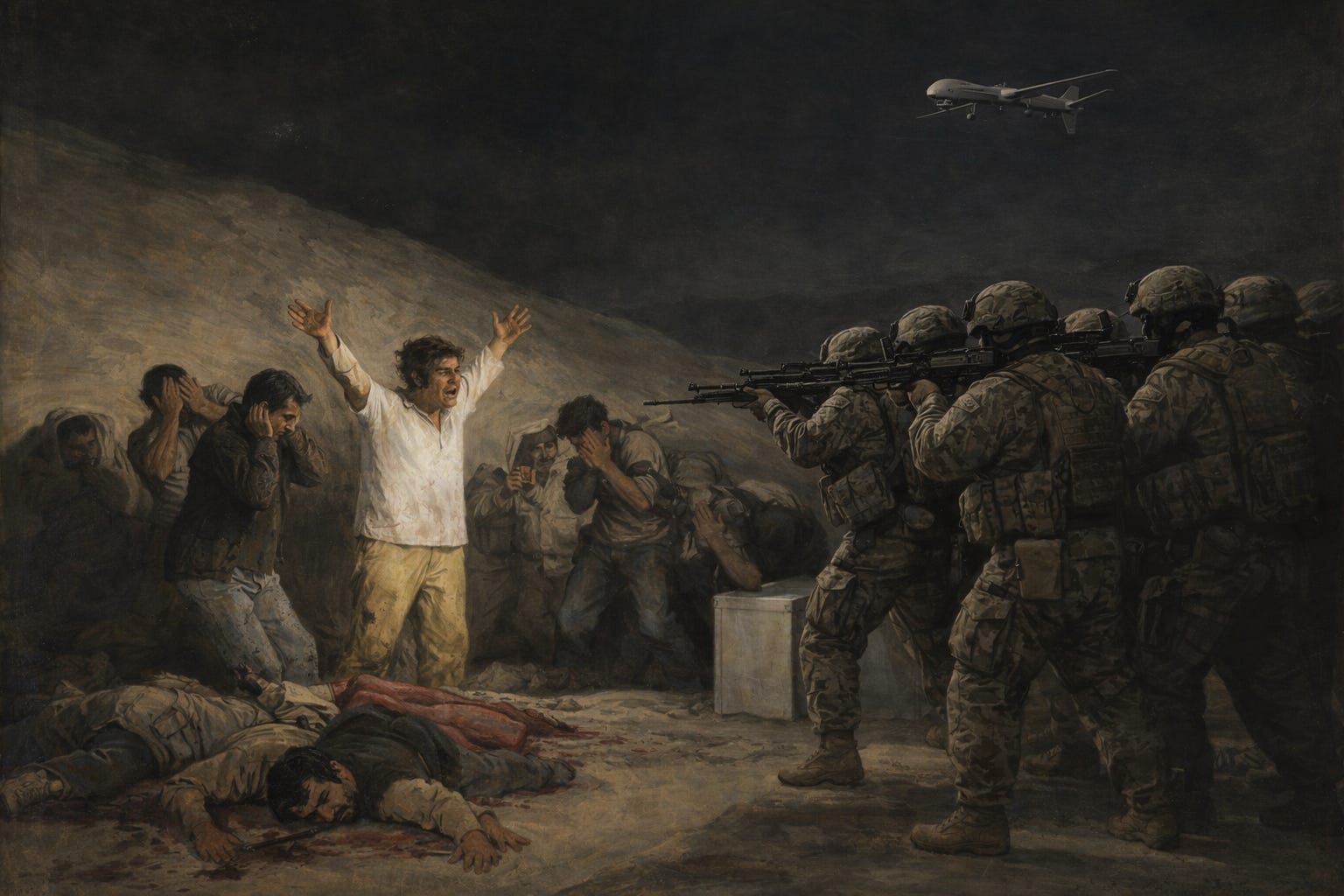
Fear Is Not a Legal Principle
If you are willing to let the federal government kill people because it makes you feel safe, without legal justification, domestically or internationally, then you are not defending law and order. You are endorsing its suspension. You are declaring due process optional.
No amount of moral disgust nullifies a person’s right to life or their right to defend themselves. That principle is not sentimental; it is foundational. In 2009, the U.N. Human Rights Committee stated the matter plainly:
While States have an obligation to protect their citizens by preventing and punishing criminal violence, this obligation goes together with the State’s duty to ensure respect for the right to life of all citizens, including that of criminal suspects.
This position is not foreign to American values. It is echoed in the Constitution, in the writings of the Founders, in international law, and in the very statutes governing drug enforcement. Every one of them insists on legal process, not execution by impulse.
The counterargument, “Americans die from drugs, therefore drug smugglers should be killed,” is not reasoning. It is an emotional reflex dressed up as moral clarity. It collapses causation into vengeance and calls the result justice. This is precisely the kind of thinking modern legal systems were designed to prevent. In the study of legal history, this logic is not taught as wisdom, but as a warning: an example of what happens when fear is allowed to overrule judgment.
It is merely “an eye for an eye” with contemporary branding, atavistic thinking updated with modern weapons. Once potential harm is allowed to justify preemptive killing, due process ceases to be a principle and becomes an inconvenience. At that point, legality is reduced to whatever violence feels emotionally satisfying in the moment.
You are not morally elevated for endorsing this. You are endorsing barbarism with a clean conscience. And it should disturb anyone that such thinking is translated into political power, into votes for officials willing to enact it in real time.
To reduce the complexity of law to “man bad, man die” should not surprise us. Rational restraint is a recent achievement in human history; fear-driven violence is not. Civilization did not arise because we lack brutal instincts, it arose because we recognized the danger of indulging them. When law gives way to instinct, we are not witnessing strength or resolve, but the older brain reasserting itself.
Civilization is measured not by how efficiently it kills those it fears, but by how rigorously it restrains itself when fear demands blood.
What Civilized Societies Already Agree On
One of the quiet achievements of modern civilization is not unanimity on culture, religion, or politics, but unanimity on restraint. Across borders, systems, and histories, states that consider themselves civilized converged on the same conclusion: the power to kill must be bound by law, process, and final judgment. This is not coincidence. It is learned memory.
That consensus is reflected most clearly in the International Covenant on Civil and Political Rights (ICCPR), ratified by the overwhelming majority of the world’s nations, including the United States. Article 6 affirms the inherent right to life and prohibits arbitrary deprivation of that life. Even where capital punishment exists, it may only follow a final judgment by a competent court. Article 9 reinforces the same principle in another register: liberty cannot be removed arbitrarily, detention must be lawful, charges must be stated, and judicial review must be available.
These are not abstract ideals. They are safeguards forged in response to the predictable failure modes of human societies, fear, vengeance, scapegoating, and the temptation to trade restraint for perceived security. They exist because history demonstrated, repeatedly, what happens when states allow themselves to kill first and justify later.
This is where the moral fracture appears. When people inside a self-described civilized society argue that these principles should be suspended when they feel strongly enough, they are not aligning themselves with civilization’s achievements. They are aligning themselves with its breakdowns. They are adopting the same logic used by authoritarian regimes, merely dressed in different language.
Authoritarian states do not typically announce that they are committing murder. They argue necessity. They argue danger. They argue prevention. They sanitize killing by calling it protection, stability, or public safety. The rhetoric is always utilitarian: some must die so others may live. That logic has been used to justify purges, exterminations, and state terror across the last century. The vocabulary changes; the structure does not.
Even if extrajudicial killing were to produce a measurable increase in safety, and that claim itself is dubious, it would not be meaningfully different from a purge that happens to be selective, or an extermination that happens to be bureaucratic. What distinguishes civilization from barbarism is not outcomes alone, but constraints. Once killing without law is accepted as legitimate, the category of who “deserves” it is limited only by fear and power.
Calling this progress because it feels effective does not make it civilized. It makes it familiar. It is the oldest argument in human history, repackaged as policy.
Civilization did not arise because humans stopped being afraid. It arose because we learned, slowly, painfully, that fear is a terrible architect of justice.
References
United Nations General Assembly. (1966). International Covenant on Civil and Political Rights. United Nations.
United Nations Human Rights Committee. (2009, June 3). Human Rights Council discusses reports on extrajudicial, summary or arbitrary executions and on violence against women. Office of the United Nations High Commissioner for Human Rights.
"fear is a terrible architect of justice."
Thank you Mr. H. for your cogent and dense work.
And authoritarian states see everything as an existential threat. Any opposition or any hint of a hazard, responding to it is opportunism. Trump and other autocrats have built their politics on their belief that enemies lurk on every corner. Trump has convinced himself that North Korea, China, Russia and Venezuela should be America's new allies, as he throws away 80 years of friendship with Europe. He claims the EU and NATO have been "ripping us off," implying that they are untrustworthy.