
Persecution Complex With Legislative Privileges
How Christian political activism learned to call its hatred liberty, and has been doing it since before the Civil War.

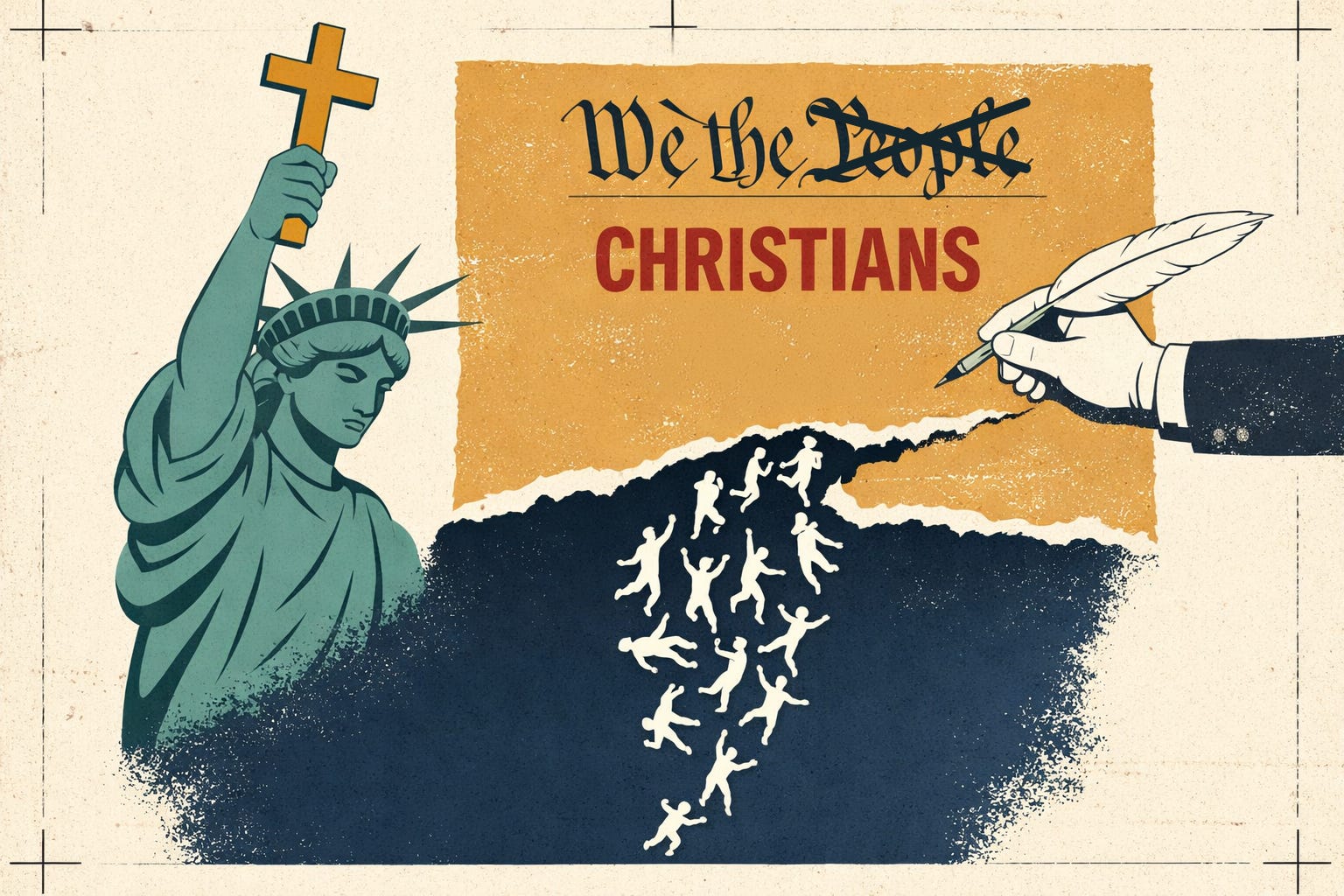
Hate Wearing a Tie
There is something worth naming about the particular cowardice of using constitutional language to deny constitutional protections. The people pushing to overturn Obergefell v. Hodges are not making a legal argument. They are making a preference argument dressed in legal vocabulary. Before Obergefell, states could and did deny marriage licenses to same-sex couples. Overturning it returns exactly one thing: the ability to do that again. There is no other consequence. There is no other goal. The constitutional objection is the costume, not the conviction.
The standard rebuttal is predictable: the Supreme Court overstepped, the Constitution does not guarantee same-sex marriage, rights cannot be conjured from the Due Process Clause. What this argument never explains is why it appears exclusively when the rights in question belong to people who have historically been denied them. There is no equivalent movement to overturn the constitutional basis for heterosexual marriage, because no such basis was ever needed. Heterosexual marriage was the default. The norm. The assumed. You do not pass laws to protect the thing that has never been threatened.
This is the tell that exposes every argument of this kind. Show me a law ever written to protect white people from discrimination strictly because they were white. Show me a ruling that had to establish the right of straight couples to marry. These laws do not exist because the legal system was built around the assumption that these groups required no protection, because the system was built by and for them. The demand for legal protection only becomes necessary when a group has enemies with power. The groups who have never needed that protection are, without exception, the groups who held the power.
Using the Constitution to deny the protections the Constitution exists to provide is not a legal position. It is hate wearing a tie. And the people who vote for representatives who bring these measures to a floor vote are not bystanders to that hate. They are its authors.
A Documented Asymmetry
There is a talking point that both parties are the same, that the left is equally hateful, that the Constitution needs to be returned to its original intent by the people currently trying to strip rights from it. Contemporary American political history does not support this. When Democrats hold the White House, rights are extended or protected. When Republicans hold it, rights are targeted for removal. It's not a matter of seeing both sides, either. It is a documented asymmetry. Only Republicans are pursuing the overturn of Obergefell, with Republican lawmakers in at least nine states introducing resolutions urging the Supreme Court to strike it down in 2025 alone (NBC News, 2025). Only Republicans passed the trans executive orders, beginning on the first day of the second Trump administration (Trump, 2025). Only Republicans defunded the crisis line for LGBTQ youth, with the Trump administration formally terminating the 988 Lifeline’s LGBTQ Youth Specialized Services in July 2025 (The Trevor Project, 2025), while the Attorney General simultaneously instructed the FBI to treat trans activists as domestic terrorist groups and establish cash bounties for their arrest (Bondi, as cited in Center for Constitutional Rights, 2025). The pattern is not subtle enough to require interpretation.
On the Bible: religious freedom is a genuine and protected right. It guarantees you the freedom to believe, to worship, and to live according to your faith. It does not guarantee you the freedom to govern other people’s lives by it. The moment your religious belief becomes a legal mechanism to deny someone else a civil right, you have left the territory of religious freedom and entered the territory of theocracy. These are not the same place.
The argument that always follows is that affirming LGBTQ rights forces religious people to violate their conscience. But examine what that argument actually requires. It requires that a same-sex couple’s legal marriage, a civil arrangement between two people and the state, constitutes an act of aggression against a third party who simply disapproves of it. That is not a conscience being violated. That is a preference being frustrated. The distinction matters enormously, because one is a rights claim and the other is a complaint that someone else has rights you wish they didn’t.
If the only harm done to you by another person’s freedom is that they have it, you have not been wronged. You have simply lost the power to wrong them. And the fact that your position only acquires legal force when you successfully elect people who share your contempt for that group is not evidence that your position is principled. It is evidence that it is political. Hate does not become a constitutional argument because you found legislators willing to dress it that way. It remains what it is. The clothing is borrowed. The animus is original.
The Ordinance of the Creator
The church has never needed to announce its hatred. It has always had better words for it.
Thornton Stringfellow was a Baptist minister in Virginia who in 1841 published a theological argument that God had not only permitted slavery but actively sanctioned it, tracing the institution from Abraham through Moses through the New Testament and concluding that scripture offered no condemnation of owning human beings, only endorsement (Stringfellow, 1856). He did not write as a hateful man. He wrote as a faithful one, marshaling chapter and verse to demonstrate that the subordination of Black people was consistent with divine will and that abolitionists were simply poor readers of scripture. Twenty years later, Alexander Stephens stood before a crowd in Savannah and declared that the Confederacy was the first government in the history of the world built explicitly on the truth of racial hierarchy, and that this hierarchy was not a political preference but a conformity with the ordinance of the Creator (Stephens, 1861). He was the Vice President of the Confederate States of America, and he said it in public, to applause. Neither man described himself as motivated by hate. Both described themselves as motivated by truth, one scriptural, one governmental, and both reached for God to sign the document.
A century later, Leon Bazile was a judge in Caroline County, Virginia, who in 1965 denied a motion to vacate the convictions of Richard and Mildred Loving, an interracial couple who had been arrested in their bedroom for the crime of being married. In his ruling, Bazile wrote that God had created the races and placed them on separate continents, and that this separation was evidence of divine intent that they should not mix (Bazile, as cited in Loving v. Virginia, 1967). This was not a sermon. It was a legal ruling. It was issued in a courthouse, by a man in a robe, with the full authority of the state of Virginia behind it. Mildred Loving was alive until 2008. This is not ancient history. It is the recent past dressed in a collar.
The pattern is not complicated once you see it. The method is always the same. You locate the group you wish to harm, you find the passage that can be made to justify the harm, and you present the whole arrangement as the will of God rather than the preference of men. This insulates the position from ordinary moral scrutiny because you are no longer arguing policy, you are transmitting revelation. It also conveniently absolves you of the animus, because the hatred is not yours, it belongs to the Almighty, and you are merely its humble instrument. What makes this maneuver so durable is that it works in every era and requires only minimal retooling between applications. Stringfellow needed Genesis and the Pauline epistles. Bazile needed the geography of continents. The legislators currently writing bills to strip rights from LGBTQ Americans need Leviticus, and they have been using it with the same confidence, and the same claim to divine sanction, as every predecessor in this line.
There is a deflection that appears reliably in these conversations, which is the suggestion that criticizing Christian legislative activism requires you to also defend what happens to LGBTQ people in Saudi Arabia or Iran. This argument deserves exactly the amount of time it takes to name it. It is an invitation to measure American Christians against theocrats rather than against the values American Christians themselves profess. It is also a concession dressed as a counterattack, because the person making it has quietly accepted that their position requires a comparison to a theocracy to look reasonable. The standard being proposed is not a high one, and the fact that it is the standard being proposed tells you something.
What connects Stringfellow’s study in Virginia to Bazile’s courtroom to the current session of Congress is not religion. Religion is the vehicle. What connects them is the decision to reach for the largest available authority to justify what you have already decided you want to do, and then to present the cruelty as something you were commanded to perform. The people writing these laws go to church on Sunday and mean every word of both.
The Selective God
There is a very specific kind of intellectual dishonesty that requires you to hold two things simultaneously: that God is unconditional love, and that God authored instructions to kill gay people. The passage in question, Leviticus 20:13, sits in a section of text that also prescribes death for adultery, demands the execution of anyone who curses their parents, prohibits the eating of shellfish, forbids the mixing of fabrics, and permits the sale of human beings captured from neighboring nations (Leviticus, n.d.). Nobody is organizing a political movement around the shellfish prohibition. Nobody is introducing legislation about linen and wool. These verses exist in the same chapter, written by the same hand, claiming the same divine authority, and they are ignored with complete comfort by the same people who treat Leviticus 20:13 as the cornerstone of a legislative agenda. The selectivity is not incidental. It is the entire mechanism.
What is being practiced here is not theology. It is targeting. The text is not being applied consistently because consistent application was never the goal. The goal was to locate a passage that aimed at the group already being aimed at, and to present that passage as revelation rather than preference. This is what makes the religious freedom argument so particularly dishonest when it is deployed in this context, because the freedom being claimed is not the freedom to believe or to worship. It is the freedom to use the state to do what the scripture technically recommends but the modern world will not permit them to do literally. The legislative bill is the domesticated version of Leviticus. The prison sentence or the denial of rights is what you get when you cannot get what the text actually prescribes.
The argument that recognizing LGBTQ rights forces religious people to violate their conscience requires very careful examination because it does not survive it. What it actually requires you to believe is that another person’s legal existence, their civil marriage, their right to adopt, their protection from being fired, constitutes an act of violence against someone who simply disapproves of them. A bakery owner in Colorado is not being asked to renounce Christ. He is being asked to sell a cake. A county clerk in Kentucky is not being asked to perform a same-sex marriage in her church. She is being asked to issue a civil document on behalf of a government that is not a religious institution. The conscience being claimed as violated is not a conscience at all. It is a preference for a world in which certain people do not have rights, and the religious vocabulary is the mechanism by which that preference gets to present itself as something more dignified than what it is.
The Jesus of the New Testament, the one these same people invoke when they need the all-loving God, said nothing about homosexuality. Not one recorded word. He had considerable things to say about wealth, about hypocrisy, about the treatment of the poor and the outcast, and about the particular spiritual danger of people who make a public performance of their piety. The Christians currently most invested in stripping rights from LGBTQ Americans are, by any honest reading of the text they claim as their authority, much closer to the people Jesus reserved his harshest language for than to anything he asked his followers to become. That is not an argument against Christianity. It is an argument against the specific and selective use of Christianity as a political instrument, which is a different thing entirely, and a distinction its practitioners are counting on you not to make.
References
NBC News. (2025, February 26). Lawmakers in 9 states propose measures to undermine same-sex marriage rights. https://www.nbcnews.com/nbc-out/out-politics-and-policy/lawmakers-9-states-propose-measures-undermine-sex-marriage-rights-rcna193743
The Trevor Project. (2025, July 17). Closed: Trump admin officially shuts down the 988 Suicide & Crisis Lifeline’s LGBTQ+ youth specialized services. https://www.thetrevorproject.org/blog/closed-trump-admin-officially-shuts-down-the-988-suicide-crisis-lifelines-lgbtq-youth-specialized-services/
Trump, D. J. (2025, January 20). Defending women from gender ideology extremism and restoring biological truth to the federal government [Executive Order 14168]. The White House. https://www.whitehouse.gov/presidential-actions/2025/01/defending-women-from-gender-ideology-extremism-and-restoring-biological-truth-to-the-federal-government/
Center for Constitutional Rights. (2025, December 23). We must not look away: The escalating targeting of trans people. https://ccrjustice.org/home/blog/2025/12/23/we-must-not-look-away-escalating-targeting-trans-people
The Bible: Leviticus (n.d.). Various translations. For the King James Version, see https://www.kingjamesbibleonline.org/Leviticus-Chapter-20/
Stephens, A. H. (1861). Cornerstone speech. In H. Cleveland (Ed.), Alexander H. Stephens, in public and private: With letters and speeches, before, during, and since the war (pp. 717–729). L.C. Collins. (Original speech delivered March 21, 1861, Savannah, Georgia) https://www.battlefields.org/learn/primary-sources/cornerstone-speech
Stringfellow, T. (1856). Scriptural and statistical views in favor of slavery. J. W. Randolph. https://www.loc.gov/item/06044897/
Loving v. Virginia, 388 U.S. 1 (1967). https://www.law.cornell.edu/supremecourt/text/388/1
Russell, J. (2026, March 11). "Political suicide": Idaho Republicans vote no on overturning same-sex marriage. LGBTQ Nation. https://www.lgbtqnation.com/2026/03/political-idaho-republicans-vote-no-on-overturning-same-marriage/